
Businesses across India increasingly face challenges involving counterfeit goods, brand imitation, and unauthorised use of trademarks. As digital commerce and global trade continue expanding, companies must understand the legal remedies for trademark infringement available under Indian law. Counterfeit products not only reduce revenue but also damage brand reputation, consumer trust, and long term business value. Industries such as pharmaceuticals, electronics, cosmetics, fashion, automotive parts, and consumer goods remain particularly vulnerable to intellectual property violations.
Trademark infringement and counterfeiting have become major commercial concerns because fake products often imitate genuine branding, packaging, and product identity very closely. Businesses therefore require strong legal protection and effective enforcement strategies to prevent misuse of intellectual property rights. India has developed a comprehensive legal framework to help businesses combat trademark infringement and counterfeit activities through civil, criminal, and administrative remedies.
Understanding Trademark Infringement and Counterfeit Goods
Trademark infringement occurs when a person or business uses a mark identical or deceptively similar to a registered trademark without authorisation. Such use may create confusion among consumers regarding the origin, quality, or authenticity of products and services. Counterfeit goods are fake products deliberately designed to imitate genuine branded goods. Counterfeiters often copy trademarks, logos, packaging designs, product labels, and marketing materials to mislead consumers.
In many cases, counterfeit products are sold through online marketplaces, local retail networks, social media platforms, and unauthorised distribution channels. The rapid growth of ecommerce has further increased the circulation of fake products across domestic and international markets. Trademark infringement not only harms brand owners financially but may also create safety risks for consumers, particularly in industries involving medicines, cosmetics, food products, and electronic goods.
Importance of Trademark Protection in India
A trademark represents the identity and goodwill of a business. It helps consumers distinguish products and services from competitors. Businesses invest substantial resources in brand development, advertising, packaging, and customer trust. Trademark protection allows businesses to prevent unauthorised use of their brand identity and maintain market credibility. Registered trademarks also strengthen enforcement rights and simplify legal proceedings against infringers.
India follows a statutory system for trademark protection under the Trade Marks Act, 1999. Registration provides exclusive rights to use the trademark for specific goods or services and allows businesses to seek legal remedies against counterfeiters and infringers. Businesses may obtain official trademark related information through the Office of the Controller General of Patents, Designs and Trade Marks. Legal Remedies for Trademark Infringement in India
Civil Remedies
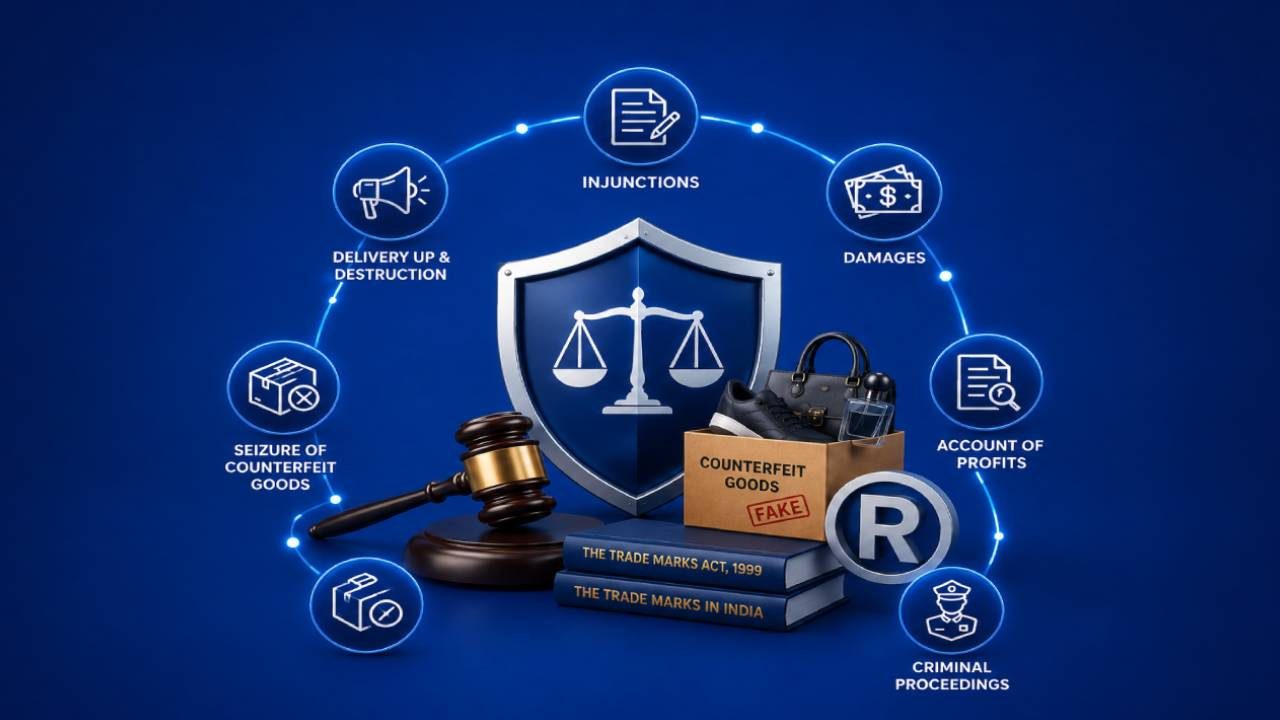
Civil remedies remain one of the most commonly used enforcement mechanisms against trademark infringement and counterfeit activities in India. Trademark owners may file civil suits before competent courts seeking injunctions against infringing parties. Courts may issue temporary, permanent, or ex parte injunctions to prevent further unauthorised use of trademarks.
An injunction restricts counterfeiters from manufacturing, selling, advertising, or distributing infringing goods. Courts may grant urgent interim relief when delay could cause significant commercial harm.
Trademark owners may also seek damages or account of profits from infringers. Damages compensate businesses for financial losses resulting from trademark misuse, while account of profits requires infringers to surrender profits earned through unlawful activities. Courts may further order seizure, destruction, or delivery of counterfeit goods, packaging materials, labels, and advertising content used for infringement activities. In certain cases, courts also issue Anton Piller orders, allowing search and seizure of counterfeit goods without prior warning to infringers. John Doe orders may also be granted against unidentified counterfeit operators. Many businesses consult an experienced anti counterfeit lawyer in India to initiate urgent injunction proceedings and coordinate enforcement actions effectively.
Criminal Remedies
Trademark infringement involving counterfeit goods may also attract criminal liability under Indian law. The Trade Marks Act, 1999 contains provisions for criminal prosecution against individuals involved in falsifying trademarks or selling counterfeit products. Criminal remedies are particularly effective in large scale counterfeit operations involving organised networks. Police authorities may conduct raids, seize counterfeit inventory, and arrest offenders after receiving complaints from trademark owners. Criminal penalties may include imprisonment and monetary fines depending on the nature and seriousness of infringement activities. Criminal enforcement often creates stronger deterrence against repeat offenders and organised counterfeit distribution systems. Businesses should maintain proper evidence, including trademark registration certificates, counterfeit product samples, invoices, photographs, and marketplace records while pursuing criminal action.
Customs Enforcement Remedies
Counterfeit goods frequently enter India through international trade channels. Customs enforcement therefore plays an important role in protecting intellectual property rights. Trademark owners may record their registered trademarks with Indian Customs authorities under Intellectual Property Rights Enforcement Rules. Once recorded, customs officials may identify and detain suspicious shipments suspected of infringing trademark rights. Border enforcement helps prevent counterfeit imports from entering domestic markets and reduces large scale distribution risks. Businesses may refer to the Central Board of Indirect Taxes and Customs for official information regarding customs enforcement procedures and intellectual property protection measures.
Passing Off Actions Under Indian Law
Even unregistered trademarks may receive legal protection through passing off actions under common law principles. Passing off occurs when a person misrepresents goods or services in a manner likely to deceive consumers into believing an association exists with another business. To succeed in a passing off action, businesses generally establish goodwill associated with the mark, misrepresentation by the defendant, and resulting damage to commercial reputation. Passing off remedies are particularly important for businesses which have not yet secured trademark registration but possess strong market recognition.
Role of Online Marketplace Enforcement
The rise of ecommerce has significantly increased trademark infringement and counterfeit sales through online platforms. Counterfeit sellers frequently misuse trademarks, product images, and packaging designs to deceive consumers. Most ecommerce platforms now maintain intellectual property protection programmes allowing trademark owners to report infringing listings and request takedown actions.
Businesses should actively monitor online marketplaces, social media platforms, and independent websites for unauthorised use of trademarks and counterfeit product listings.
Digital evidence collection has become increasingly important in online infringement cases. Screenshots, seller details, transaction records, and customer complaints often support legal enforcement efforts. Technology based monitoring systems using artificial intelligence and automated detection tools now help businesses identify suspicious listings more efficiently.
Importance of Early Enforcement Action
Delays in enforcement may allow counterfeit products to spread widely across the market. Early action helps reduce reputational damage and limits financial losses. Prompt legal intervention also strengthens consumer trust and demonstrates brand commitment towards quality and authenticity. Businesses which ignore counterfeit activities for extended periods may face greater enforcement difficulties later. Early enforcement often includes cease and desist notices, marketplace takedown requests, investigation activities, and urgent injunction applications before courts. Businesses should also maintain proper internal systems for reporting suspicious products, seller activity, and customer complaints related to counterfeit goods.
Challenges in Trademark Enforcement
Despite strong legal remedies, businesses continue facing several practical challenges in trademark enforcement. Counterfeit sellers often operate through anonymous networks and frequently change locations or seller identities. Online marketplaces and cross border trade further complicate investigation and enforcement efforts. Small and medium sized businesses may face resource limitations while pursuing continuous monitoring and litigation activities. Counterfeiters also exploit delays in enforcement processes and jurisdictional complexities. Consumer awareness remains another challenge. Many buyers unknowingly purchase counterfeit products due to lower prices or misleading advertisements. These challenges highlight the importance of comprehensive brand protection strategies involving legal, technological, and operational measures.
Role of Intellectual Property Professionals
Trademark enforcement requires strategic planning, evidence collection, legal analysis, and coordination with enforcement authorities. Businesses often work with investigators, customs consultants, and legal professionals to strengthen protection efforts. Experienced professionals help businesses secure trademark registrations, manage litigation, conduct investigations, and coordinate cross border enforcement strategies. Many companies seek guidance from best intellectual property law firms in India for trademark portfolio management, anti counterfeiting strategies, and dispute resolution support.
Building Strong Trademark Protection Strategies
Businesses should adopt preventive measures rather than relying solely on reactive enforcement. Trademark registration remains the foundation of effective brand protection. Companies should monitor online marketplaces regularly, educate distributors regarding authorised supply channels, and implement product authentication technologies where appropriate. QR codes, serial numbers, holograms, blockchain tracking systems, and tamper resistant packaging improve product authenticity verification and reduce counterfeit risks. Employee training and consumer awareness campaigns also strengthen counterfeit prevention efforts. Businesses should encourage customers to purchase products through authorised channels and report suspicious listings.
Conclusion
Trademark infringement and counterfeit goods continue affecting businesses across industries in India. As digital commerce expands and supply chains become more complex, companies must understand the legal remedies available for protecting intellectual property rights.
India provides strong civil, criminal, and customs enforcement mechanisms to address trademark infringement and counterfeit trade. Businesses adopting proactive enforcement strategies are better positioned to protect consumer trust, preserve brand value, and maintain long term commercial stability. Effective trademark protection requires a combination of legal action, marketplace monitoring, technological safeguards, and consumer awareness. Companies investing in comprehensive brand protection systems today can reduce future risks and strengthen their competitive position in evolving markets.
Frequently Asked Question (FAQs)
What are legal remedies for trademark infringement in India?
Legal remedies include injunctions, damages, seizure of counterfeit goods, criminal prosecution, customs enforcement, and marketplace takedown actions.
What is trademark infringement?
Trademark infringement occurs when a person uses a mark identical or deceptively similar to a registered trademark without permission.
Are counterfeit goods illegal in India?
Yes. Manufacturing, selling, or distributing counterfeit goods violates intellectual property laws and may result in civil and criminal penalties.
Can unregistered trademarks receive protection in India?
Yes. Unregistered trademarks may receive protection through passing off actions under common law principles.
What is an injunction in trademark infringement cases?
An injunction is a court order preventing a person or business from using infringing trademarks or selling counterfeit products.