Counterfeiting remains one of the most serious threats faced by businesses across India. From luxury goods and pharmaceuticals to electronics and consumer products, counterfeit goods can damage brand reputation, reduce revenue, and erode consumer trust. When businesses discover counterfeit products in the market, one of the most important decisions involves selecting the appropriate legal strategy. Understanding Anti-Counterfeiting Remedies is essential for businesses seeking effective protection of their intellectual property rights. Indian law offers both civil and criminal remedies against counterfeiters, each serving distinct objectives and providing different advantages depending on the circumstances of the case.
Choosing between civil and criminal action requires careful evaluation of business goals, available evidence, urgency, and the scale of infringement. A well planned enforcement strategy can significantly improve the chances of stopping counterfeit activities and recovering losses.
Understanding Counterfeiting Under Indian Law
Counterfeiting generally involves the unauthorised manufacture, distribution, sale, or marketing of products designed to imitate genuine goods. Counterfeiters often copy trademarks, packaging, labels, logos, and other brand identifiers to mislead consumers. Counterfeit products not only affect businesses but also create risks for consumers. In sectors such as pharmaceuticals, cosmetics, automotive parts, and electronics, counterfeit goods can pose serious health and safety concerns. India addresses counterfeiting through several laws, including the Trade Marks Act, 1999, Copyright Act, 1957, Designs Act, 2000, Patents Act, 1970, and various provisions of criminal law. These legal frameworks provide multiple enforcement options for rights holders.
Anti-Counterfeiting Remedies: Civil vs Criminal Enforcement
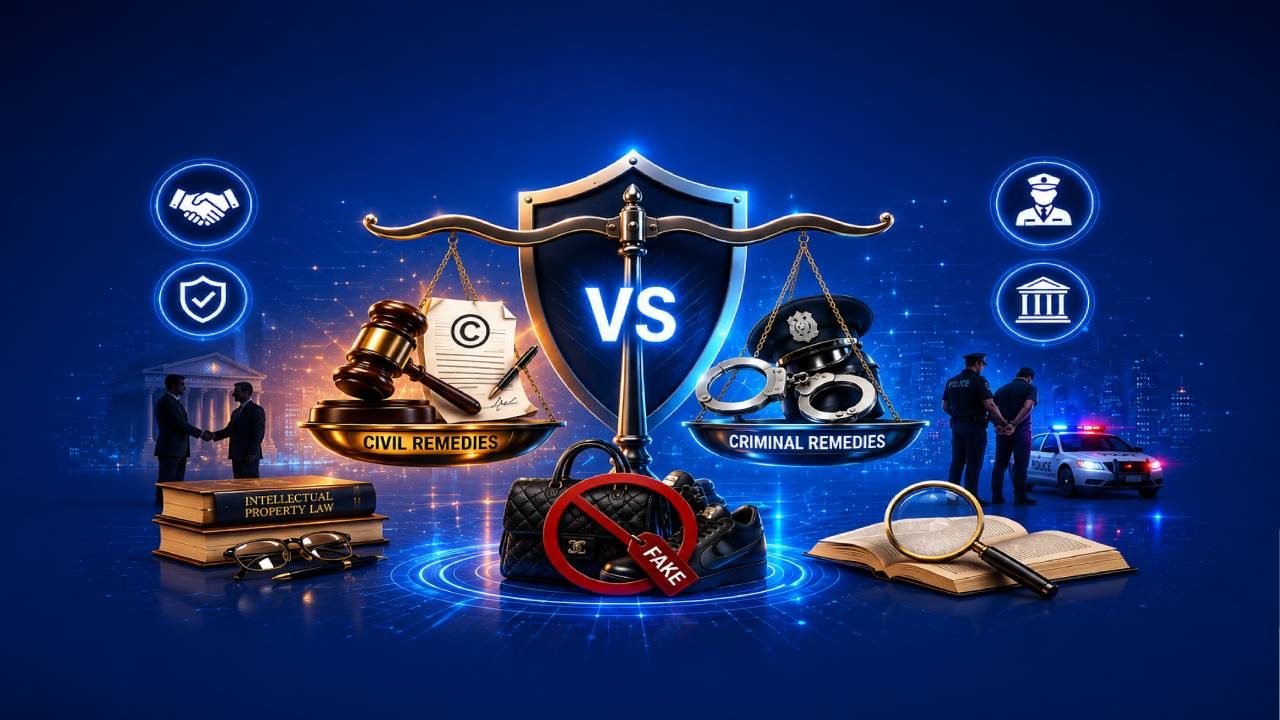
Anti-Counterfeiting Remedies in India broadly fall into two categories. Civil remedies focus on protecting private rights and compensating affected businesses. Criminal remedies aim to punish offenders and deter future violations. Both approaches can be highly effective when used appropriately. In many cases, businesses pursue civil and criminal actions simultaneously to maximise enforcement outcomes. Understanding the differences between these remedies is critical when developing an anti counterfeiting strategy.
What Are Civil Remedies in Counterfeiting Cases?
Civil remedies are legal actions initiated by intellectual property owners before civil courts. The primary objective is to stop infringement and compensate the rights holder for losses suffered. Trademark owners commonly rely on civil litigation when counterfeit products infringe their registered trademarks or trade dress.
a) Injunctions
An injunction is often the most valuable civil remedy available in counterfeiting cases. Courts may order counterfeiters to immediately stop manufacturing, selling, advertising, or distributing infringing products. Interim injunctions can be granted at an early stage when urgent protection is required. Such orders help prevent further damage while litigation continues.
b) Damages and Compensation
Courts may award monetary compensation to businesses that have suffered losses due to counterfeit activities. Damages seek to compensate rights holders for financial harm caused by infringement. In certain cases, courts may also direct defendants to account for profits earned through illegal activities.
c) Delivery Up and Destruction of Goods
Civil courts may order the seizure, surrender, and destruction of counterfeit products, packaging materials, labels, and manufacturing equipment used in infringement activities. This remedy helps remove counterfeit goods from commercial circulation and prevents future misuse.
d) Anton Piller Orders
Indian courts may grant search and seizure orders in appropriate circumstances. These orders allow the preservation of evidence before it can be concealed or destroyed by infringers. Such measures are particularly useful in large scale counterfeiting operations.
Advantages of Civil Remedies
Civil proceedings offer several advantages for intellectual property owners. They provide direct control over litigation strategy and allow businesses to seek compensation for financial losses. Civil courts can grant immediate injunctive relief, which is often crucial in preventing ongoing market damage. Civil remedies are also effective where the primary objective is stopping infringement rather than pursuing criminal punishment. Businesses seeking long term protection of their intellectual property portfolios often rely heavily on civil enforcement mechanisms.
Limitations of Civil Remedies
Despite their benefits, civil proceedings may involve lengthy litigation timelines and significant legal costs. Obtaining final judgments can take considerable time, particularly in complex cases involving multiple defendants or extensive evidence. Additionally, recovery of damages may be challenging if counterfeiters possess limited assets or operate through informal business structures. For these reasons, businesses frequently combine civil litigation with criminal enforcement measures.
What Are Criminal Remedies in Counterfeiting Cases?
Criminal remedies focus on penalising offenders and deterring unlawful activities. Counterfeiting involving trademarks and related intellectual property violations may attract criminal liability under Indian law. The Trade Marks Act, 1999 includes provisions criminalising certain forms of trademark infringement and counterfeiting. Law enforcement authorities may investigate complaints, conduct raids, seize counterfeit goods, and initiate prosecution against offenders.
a) Police Raids and Seizures
One of the most powerful criminal enforcement tools involves police action against counterfeit operations. Authorities may conduct raids on manufacturing facilities, warehouses, retail outlets, and distribution centres involved in counterfeit trade. Large quantities of counterfeit goods can be seized and removed from circulation through these operations.
b) Arrest and Prosecution
Individuals involved in counterfeiting activities may face arrest and criminal prosecution. Convictions can result in fines, imprisonment, or both depending on the nature and severity of the offence. The possibility of criminal penalties often creates a strong deterrent effect against counterfeit operations.
c) Investigation Powers
Law enforcement agencies possess investigative powers that are unavailable in civil proceedings. These powers can assist in identifying counterfeit networks, supply chains, manufacturing facilities, and key individuals involved in infringement activities.
Advantages of Criminal Remedies
Criminal enforcement often delivers swift and visible results. Police raids can disrupt counterfeit operations immediately and remove large volumes of infringing products from the market. Criminal proceedings also send a strong message to potential infringers and demonstrate a brand owner’s commitment to enforcement. Where public health or consumer safety concerns are involved, criminal remedies may be particularly effective. Many businesses facing widespread infringement consult an experienced anti counterfeiting lawyer in Mumbai to assess whether criminal enforcement is appropriate for their circumstances.
Limitations of Criminal Remedies
Criminal proceedings are controlled primarily by law enforcement authorities and prosecutors rather than rights holders. Businesses may have less influence over the pace and direction of investigations. Prosecutorial priorities and resource constraints can sometimes affect case progression. Criminal remedies generally focus on punishment rather than financial compensation. As a result, businesses may still need civil proceedings to recover damages or obtain broader commercial relief.
Factors to Consider When Choosing Between Civil and Criminal Remedies
The decision between civil and criminal enforcement depends on several factors.
a) Nature of the Counterfeiting Activity
Large scale organised counterfeiting operations often justify criminal action due to the need for immediate intervention and deterrence. Smaller disputes involving limited infringement may be effectively addressed through civil litigation.
b) Urgency of Enforcement
Where immediate market intervention is required, criminal raids and seizures may provide rapid results. Civil injunctions can also offer urgent protection, particularly when supported by strong evidence.
c) Recovery of Financial Losses
Businesses seeking compensation for economic harm typically require civil proceedings because criminal remedies focus primarily on punishment.
d) Strength of Evidence
The available evidence plays an important role in determining the most appropriate course of action. Comprehensive documentation, investigation reports, product samples, and trademark registrations strengthen both civil and criminal cases.
Can Civil and Criminal Remedies Be Used Together?
Yes. In many anti counterfeiting matters, businesses pursue both civil and criminal remedies simultaneously. A civil action may secure injunctions and compensation while criminal proceedings disrupt counterfeit operations through raids, seizures, and prosecution. This combined approach often provides the strongest protection for intellectual property rights and maximises enforcement effectiveness. Indian courts have repeatedly recognised the legitimacy of parallel civil and criminal proceedings in intellectual property disputes.
The Role of Intellectual Property Registration
Strong intellectual property protection begins with proper registration. Registered trademarks provide the foundation for most anti counterfeiting enforcement actions. Courts, law enforcement agencies, customs authorities, and online platforms frequently require proof of ownership before taking action against infringers. Businesses can access registration procedures and guidance through the Office of the Controller General of Patents, Designs and Trade Marks, which administers intellectual property registrations in India. Maintaining updated intellectual property portfolios significantly improves enforcement outcomes.
Developing an Effective Enforcement Strategy
Every counterfeiting case presents unique challenges. Businesses should evaluate the scale of infringement, commercial impact, available evidence, and enforcement objectives before selecting a legal strategy. Proactive monitoring, marketplace investigations, customs recordation, consumer education, and timely legal action all contribute to successful anti counterfeiting programmes. Many businesses collaborate with the best IP firms in India to develop comprehensive enforcement strategies tailored to their industries and risk profiles.
Conclusion
Counterfeiting can have severe consequences for businesses, consumers, and the economy. Indian law provides robust Anti-Counterfeiting Remedies through both civil and criminal enforcement mechanisms. Civil remedies are often preferred when businesses seek injunctions, compensation, and long term protection of intellectual property rights. Criminal remedies are particularly effective when rapid intervention, seizure of counterfeit goods, and deterrence are priorities. In many situations, a combined approach delivers the strongest results. By understanding the strengths and limitations of each remedy, businesses can make informed decisions and build effective anti counterfeiting strategies capable of protecting valuable brands and intellectual property assets.
Frequently Asked Questions (FAQs)
What are anti counterfeiting remedies?
Anti counterfeiting remedies are legal measures available to intellectual property owners to stop counterfeit activities, recover losses, and enforce intellectual property rights.
What is the difference between civil and criminal remedies in counterfeiting cases?
Civil remedies focus on injunctions, damages, and protection of private rights, while criminal remedies aim to punish offenders through prosecution, fines, and imprisonment.
Can trademark owners pursue both civil and criminal action?
Yes. Indian law permits parallel civil and criminal proceedings in many counterfeiting and trademark infringement cases.
Which remedy is faster in anti counterfeiting cases?
Criminal raids and seizures often produce immediate results. Civil courts can also grant urgent interim injunctions when supported by sufficient evidence.
Can businesses recover financial compensation through criminal proceedings?
Generally, criminal proceedings focus on punishment. Businesses usually need civil actions to seek damages and compensation.